So I wrote earlier about the basic IVF process, but I wanted to go into a little more detail about what will happen retrieval and transfer-for those of you that are interested. So the day on the egg retrieval, they will put me under and take out all those eggs that we have been stimulating. They will place the eggs and sperm in a dish to do their thing. Once the sperm enters the egg, it is now called a zygote. Remember Biology…were you awake that day? I semi-was….Remember: My gametes meet his gametes and make a zygote. Here is a photo….the two little circles are the genetic material from each person! So cool….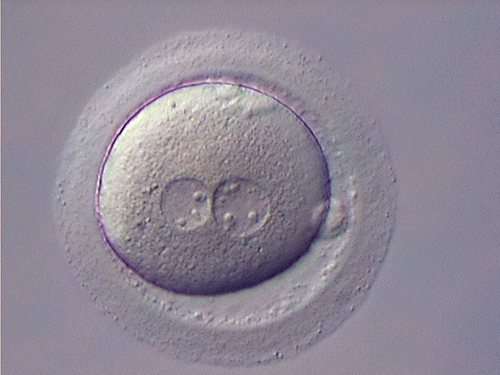 During IVF, all these processes that normally take place in the fallopian tubes (of which mine are struggling), are now taking place in a little petri dish in a lab. Those cells start to divide in the dish. After three days in the cultured environment, the embryos have hopefully divided into 6-8 cells.
At this point, good quality embryos may be placed back in the uterus, where they will float around for a couple of days before implanting in the uterine wall. Recent breakthroughs in IVF technology have allowed us to potentially go one step further in the culturing process, therefore increasing chances of implant-worthy embryos. Now, instead of placing the embryos back in the body after three days, extremely high quality embryos stay in the lab culture environment for two extra days in the hopes that they will become blastocysts. Blastocysts are the Holy Grail of IVF. Ready to immediately implant and proven to be able to withstand the test of time/development, blastocysts have an excellent chance of resulting in pregnancy. Here is a photo… So these guys are your optimal embryos to transfer, but you run a slight risk of leaving them in the culture environment for the two extra days to see if they will become blastocysts. No matter how far science has come, the embryos still thrive better in the uterine environment than in the lab. Therefore, the embryologist has to make the decision to either transfer at day three or risk the extra two days to get the embryos to the super sticky blastocyst stage. This will depend on quality, grading, and # of embryos available. Just one of the many gambles we will take during this adventure!
 Gambling with the Moon